
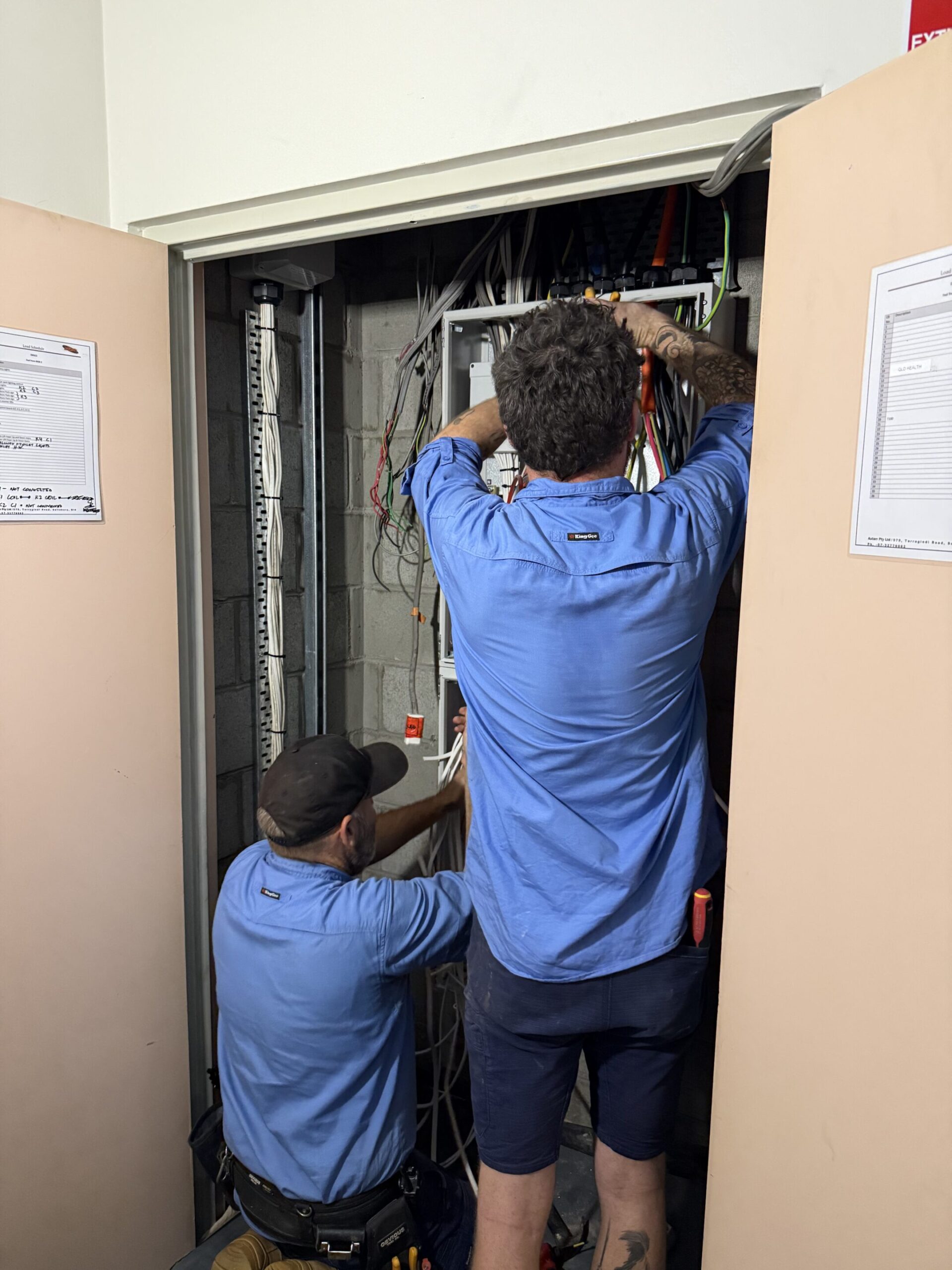
Dimming lights and your aircon: normal or not?
Lights dimming when the air conditioner starts is usually a normal, brief dip caused by the unit's startup surge. A deep or lasting drop can point to a circuit, wiring or switchboard problem worth checking.
- Quick dip, back to normal in about a second: very likely just the startup surge.
- Deep, slow to recover or getting worse: get it checked.
- Buzzing, sizzling or a burning smell: switch the unit off and call us.
If you've noticed the lights dim every time the air conditioner starts during a Moreton Bay summer, you're probably wondering whether it's urgent or whether you'd be wasting a callout. Fair question. Here's how to tell the difference, and what to do about it.
Is it normal for lights to dim when the air conditioner starts?
Mostly, yes. A quick dim that's over in about a second, where the lights barely change, is normal for a lot of homes. Every electrical supply has a bit of give in it, and a big motor starting will tug on it for a moment.
What isn't normal is dimming that's deep, slow to recover, getting worse over time, or paired with other symptoms. We'll cover those below.
A simple test
If the dim is quick and the lights are back to normal before you've finished noticing it, it's very likely just the startup surge. If you can hear the unit working hard, or the flicker carries on after it's running, treat it as a sign that something's drawing more than the circuit can comfortably deliver.
Why a starting air conditioner pulls power from your lights
The compressor is the heart of your air conditioning system. When it starts, it draws a big burst of current for a fraction of a second. Electricians call that inrush current, and it can be several times higher than what the unit draws once it's running.
That surge causes a voltage drop along the wiring. Everything on the same supply feels it, including your lights. The bigger the surge, and the more the wiring struggles to deliver it, the more the lights dim.
Think of it like a few people turning on taps at once. The pressure drops for everyone until things settle.
How much dimming is too much
Overseas sources suggest a small dip, around 5% or so, lasting a second or less is typically fine. Losing around 40% of the brightness or more can mean the compressor is struggling to start. That's a rough guide, not a rule.
How bright do the lights stay when the unit starts?
Illustrative only. Rough guide, not a rule.
| What you notice | What it usually means | Action |
|---|---|---|
| A brief dip, back to normal within about a second | Normal startup surge | Normal |
| Noticeable dimming that lasts several seconds | Worth getting checked | Get it checked |
| Brightness drops by about half | Likely a fault or overloaded circuit | Call us |
| Flickering that gets worse over time | Underlying problem, call an electrician | Call us |
Watch for the pattern too. Does it happen every time? Did it start after a new unit went in? Is it only certain areas of the house? Those details help your electrician find the cause fast.
What can cause deeper dimming
Loose connections
At the switchboard, isolator or air conditioner.
Weak start capacitor
The compressor works harder at startup.
Shared circuit
Aircon on the same wiring as lights or power points.
Undersized wiring
Cable too thin means a bigger voltage drop.
Switchboard at its limit
Old boards carrying more than they were built for.
Supply from the street
A neighbour's lights dim too? Ring Energex.
Loose or damaged connections on the circuit
A loose connection at the switchboard, the isolator or the air conditioner itself adds resistance. More resistance means a bigger voltage drop when the compressor kicks in.
The signs are flickering lights, buzzing or sizzling sounds, or a warm or discoloured fitting. If you smell burning, switch the unit off and call us. Don't poke around. Loose connections are a fire risk, and they're one of the more common causes we find.
A weak start capacitor in the air conditioner
The start capacitor gives the compressor a boost to get going. Over time it can weaken. When it does, the compressor works harder at startup, draws power for longer and the dimming gets deeper. One source reports lights losing up to 30 to 40% of their brightness with a failing capacitor.
This one's usually an air conditioning technician's job rather than an electrician's. A fitter can test the capacitor, replace it, or fit a hard start kit to ease the load. If your electrician finds the circuit is fine, the capacitor is the next place to look.
The air conditioner sharing a circuit with lights or power points
Your air conditioner should have its own dedicated circuit. If it's sharing with lights, power points or other appliances, every start-up lands on the same wiring those lights are using.
It's more common in older homes, or where an air conditioner was added later and tapped off an existing circuit. A dedicated circuit gives the unit its own supply, and that usually settles the dimming.
Undersized wiring and a switchboard at its limit
Sometimes the wiring is simply too thin for the job. Undersized cable means a bigger voltage drop under load. The switchboard can be the weak link too, especially an old one that's carrying more than it was ever designed for.
Add up what a modern family home runs at once: air conditioning, a hot water system, a cooktop, a dryer, maybe an EV charger. A switchboard from decades ago wasn't built with that load in mind. If your board is old, crowded or uses ceramic fuses, an upgrade may be the real fix, and it's good for safety as well.
There's a limit on voltage drop
The Australian and New Zealand Wiring Rules (AS/NZS 3000, clause 3.6) limit voltage drop from the point of supply to any point in the installation to 5% of the nominal voltage. That's 11.5 V on a 230 V supply. Thin cable, long runs and tired connections all eat into that allowance.
Dimming after a new split system install: what to ask
If the dimming started right after a new unit went in, the installer's work and the circuit are the first things to look at. Ask these:
- Was a dedicated circuit installed, or was the unit connected to an existing one?
- Was the circuit and breaker sized for this specific unit?
- Did anyone check the switchboard and supply could handle the extra load?
- Does the unit have a soft start, or can a hard start kit be fitted?
Heads up: installing the circuit is electrical work, and it needs a licensed electrician. If you're not sure who did it, we can inspect it and tell you straight.
Older Moreton Bay homes with newer, bigger air conditioners
Plenty of homes around North Lakes, Caboolture, Redcliffe and Bribie Island were wired long before ducted or large split systems were common. Older homes can struggle with modern demand.
Put a big new air conditioner on an old supply and something has to give. Usually it's the lights, and that's your early warning. It's the house telling you the wiring or the switchboard is working harder than it should.
What you can safely check yourself and what to leave alone
Safe to do yourself
- Note when it happens, and which lights dim
- See if it happens with other appliances too
- Turn off other things on the same circuit and see if it improves
- Ask a neighbour whether theirs dim too
Leave these alone
- Opening the switchboard
- Touching wiring
- Opening the outdoor unit
- Swapping to LED globes (it won't fix a circuit issue)
If the neighbours' lights dim too, the issue may be the supply from the street, and Energex is the one to ring. Their number for reporting flickering is 13 62 62. And swapping to LED globes is a bit like turning the radio up to hide a noisy engine.
When to call a licensed electrician
Call us if you notice any of these:
- Dimming that lasts several seconds or cuts brightness by around half
- Buzzing, sizzling or a burning smell
- The breaker tripping when the unit starts
- Flickering that's getting worse
- Dimming that started after a new unit was installed
- Lights dimming in more than one area of the house
Burning smell or sparking? Treat it as an emergency.
Switch the unit off and ring our 24/7 emergency line.
What an electrician checks and how it gets fixed
We start by measuring the voltage at startup, then check the connections, the circuit, the wiring size and the switchboard. Depending on what we find, the fix might be:
| What we find | The fix | Who does it |
|---|---|---|
| A loose connection | Tightening or replacing it | Electrician |
| Aircon sharing a circuit | A dedicated circuit for the air conditioner | Electrician |
| Undersized wiring | Replacing the wiring | Electrician |
| An old or overloaded switchboard | A switchboard upgrade | Electrician |
| A weak capacitor or hard starting | Capacitor replacement or a hard start kit | Air conditioning technician |
| Flicker across the street | Report it to the network | Energex |
The process is simple:
Step 1: Tell us
Call, fill in the form or send photos of your switchboard.
Step 2: We check
We test the voltage, connections, circuit and switchboard.
Step 3: Fixed price, then fixed
You get an upfront fixed written quote, usually within 24 hours for standard jobs, before any work starts.
We also look at how much energy the rest of the house is drawing at the same moment. A hot water system or oven that turns on at the same time makes everything worse. Our electric and electrical services cover the lot, so you don't need to chase several tradies. If the air conditioner itself is the problem rather than the wiring, we'll say so and point you to the right service.
Get it sorted properly
Connected Electricians and Cablers is a family-owned business in Bellmere, servicing Moreton Bay and the Brisbane Northside. Our owner-electrician was named Master Electrician of the Year for South East Queensland in 2021, we hold Electrical Contractor Licence #90211, and every job carries our 5-year workmanship guarantee. Our Google rating is 5.0, and customers regularly mention how tidy the work is.
Dimming lights and aircon: questions we get asked most
Is it normal for lights to dim when the air conditioner starts?
Usually, yes, if the dip is quick and the lights are back to normal in about a second. Deep, slow-to-recover or worsening dimming is worth checking.
Why does my air conditioner make the lights dim?
When the compressor starts, it draws a big burst of current called inrush current. That causes a voltage drop along the wiring, and everything on the same supply, including your lights, feels it.
Could it be a faulty capacitor?
It can be. A weak start capacitor makes the compressor work harder at startup and the dimming gets deeper. A fitter can test it, replace it or fit a hard start kit.
Should my air conditioner be on its own circuit?
Yes. If it shares a circuit with lights or power points, every start-up lands on the same wiring. A dedicated circuit usually settles the dimming.
Do my neighbours' lights dim too?
Worth asking. If they do, the issue may be the supply from the street, and Energex is the one to ring on 13 62 62.
Will LED globes fix it?
No. Swapping globes won't fix a circuit issue. It only masks the symptom.
Lights dimming when the aircon starts?
Call us or send the details through our booking form. We'll tell you whether it's normal or something that needs fixing, and we won't make it complicated.
Get it checkedSources: Cool Today: Why do my lights dim when my AC comes on?; Energex: report flickering; Energex: when power goes out; EWOQ: voltage issues and poor-quality supply; Elek: voltage drop limits (AS/NZS 3000 clause 3.6). Thresholds are rough guides, not rules.