
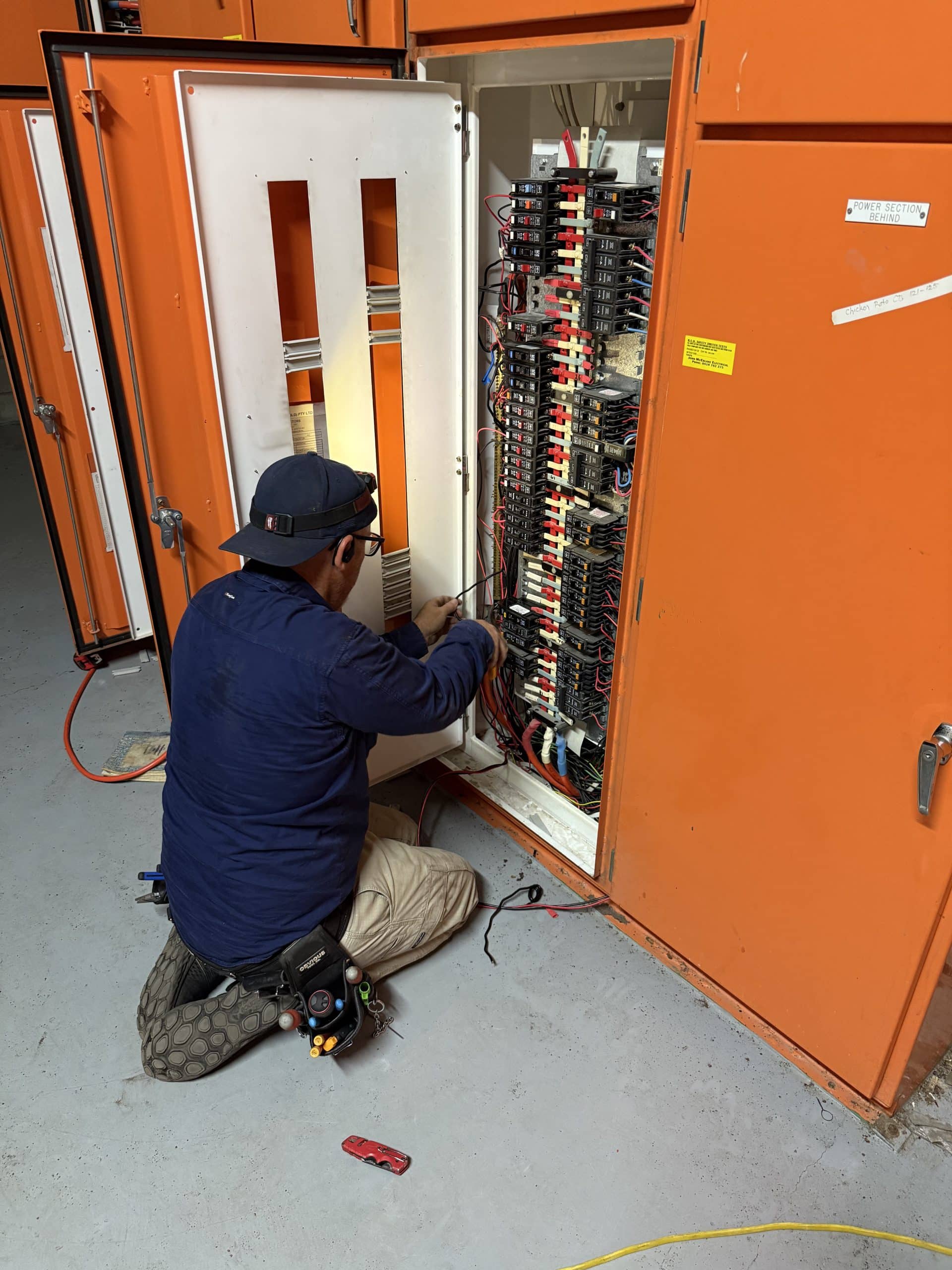
Dead power points: your 60-second triage
If the power points in one room have stopped working, the cause is usually a tripped safety switch or circuit breaker, a faulty appliance, or a loose or failed power point. You can safely check the first two before you call anyone.
- Test the appliance first. Try a lamp you know works in the same power point.
- Check the pattern. One point, one room or the whole house?
- Check the switchboard, but leave it alone if it's old, wet or damaged.
Maybe a power point or a whole room went dead and the safety switch won't stay on. Either way, you want to know if this is urgent or whether you're about to waste a callout. Here's what to check, what to leave alone, and when it's time to ring an electrician.
Start here: is it the appliance or the power point?
Before you blame the wall, blame the thing you've plugged in. Plug a lamp, or something you know works, into the same power point. If the lamp comes on, the original appliance is the problem. If it doesn't, move on.
It sounds too simple, but appliances fail more often than power points do. A quick test saves you a lot of worry.
Appliances can fail in ways that look like power point faults. A cord that's frayed inside, a plug with a loose pin or a motor that's seized can all trip a safety switch and leave you thinking the wall is the problem. That's why we test the appliance first. It takes thirty seconds, and it can save you a callout.
Check whether the other power points in the room are dead
Walk around the room and try every power point. Then try one at the opposite end of the house.
| What you find | What it likely means | Next step |
|---|---|---|
| One power point dead | That point is probably faulty or has a loose connection. | Get it checked |
| Several in the room dead, rest of the house fine | You've likely lost one circuit. | Check the switchboard |
| Whole house dead | This isn't a room problem at all. Look at the main switch, and check for a wider outage. | Check the street |
That pattern is one of the first things an electrician wants to know, so it's worth writing down.
Look for a tripped safety switch or circuit breaker
Head to your switchboard. Safety switches and circuit breakers protect your wiring and your family, and when something's wrong they cut the power on purpose.
Look for a switch that's dropped to the off position, or one that sits differently from the rest. Power points and lights are usually on separate circuits, so one might trip while the other stays on.
If you're not comfortable at the switchboard, or the board is old, wet or damaged, leave it and call us.
A quick word on the difference between the two devices. A circuit breaker protects the wiring from overloads and short circuits. A safety switch, also called an RCD, protects people by cutting the power if it senses current leaking, for instance through a faulty appliance. Both can be the reason a room goes dead, so it helps to know which one has tripped.
Circuit breaker
Protects: your wiring and equipment.
Trips on: overloads and short circuits.
How to spot it: it has no test button.
Safety switch (RCD)
Protects: people.
Trips on: current leaking, for instance through a faulty appliance.
How to spot it: it has a "T" or "Test" button.
How to reset safely and find the appliance causing the trip
If a switch has tripped, this is the safe way to find the cause:
Unplug
Unplug everything on that circuit. Switching off at the wall isn't enough.
Reset
Reset the safety switch or breaker.
Test one by one
Plug appliances back in one at a time, switching each on.
Spot the culprit
If it trips again, the last thing you plugged in is likely faulty. Leave it unplugged.
Trips with nothing plugged in? Stop there.
That points to a wiring or circuit fault, and it's time to call a licensed electrician. Don't keep resetting it.
Why the lights can work when the power points don't
Lighting and power points sit on separate circuits. So you can lose one and not the other.
Lights work, power points don't
The power circuit has failed or tripped.
Power points work, lights don't
The lighting circuit is the problem.
It's not a mystery. It's just how your home is wired. It does help us a lot when you describe it, though.
Moisture and wet areas: bathrooms, laundries and outdoor points
Water and electricity are a bad mix, and Moreton Bay's wet weather makes it a common cause. Bathrooms, laundries, kitchens and outdoor power points are the usual trouble spots.
If water has got into a power point, a safety switch can trip and keep tripping. Don't test or try to dry the point yourself. Switch off the circuit, keep people away from it and let a licensed electrician check it. Even after it dries out, the fitting may need replacing.
Loose connections and failed power points
Inside the wall, wires connect to the back of the power point. Over the years those connections can work loose, corrode or overheat. Power points also wear out, especially the ones that get plugged and unplugged all the time.
Signs of trouble:
A power point that's warm to the touch
Scorch marks or discolouration
Buzzing or crackling
Plugs that fall out or feel loose
A burning smell
If you notice any of these, switch off at the board and call us. A loose connection can cause a fire. It's also a bigger issue when one faulty point is feeding others further along the circuit, because it can knock them out too.
Overloaded circuits and double adaptors
Too many appliances on one circuit will trip it. So will a power board plugged into another power board, or a double adaptor running a heater, kettle and toaster.
Try unplugging a few things, wait a minute and try again. If the circuit then stays on, you've probably been overloading it. If you find yourself relying on extension leads and adaptors, it's usually a sign you need more power points.
Older homes with fuses or ageing wiring
Some older homes still have ceramic or porcelain fuses instead of a modern switchboard with safety switches and circuit breakers. If a fuse has blown, it's likely there's an underlying reason.
Older wiring can also deteriorate. Insulation gets brittle, and connections loosen. A switchboard upgrade protects you better, and it's a good time to check the rest of the system.
Not sure what you've got? Send us a photo of your switchboard. We can usually tell you straight away what you're dealing with.
Never fit a stronger fuse or "whatever wire is handy"
If your home still has fuses, a dead room might simply be a blown fuse. It's tempting to replace it with whatever wire is handy. Please don't. A fuse that's too strong won't protect the wiring, and that's how fires start. Call us and we'll sort it out properly.
Storms and wet weather: what to check after an outage
After a storm, first work out whether it's just you. Look at the street. Are the neighbours' lights on? If they're off, the problem is the network, and your electricity distributor, Energex, is the one to contact on 13 62 62.
If the street has power and you don't, check your main switch and safety switches. Storms can trip them, and water can get into outdoor points, meters and fittings. If a safety switch won't reset, don't keep forcing it. Leave it off and call us. We answer after hours.
What you should never do yourself
In Queensland, electrical work has to be done by a licensed electrician. That's not red tape. It's there because faulty work can cause shocks and fires.
Don't
- Open a power point or take a cover off
- Touch exposed wires
- Reset a switch again and again if it keeps tripping
- Try to dry out or test a wet power point
- Use a faulty power point with an adaptor "just for now"
Do
- Test your safety switches every three months with the test button
- Cover up a broken power point and stop using it
- Switch off at the board if you smell burning
- Call a licensed electrician
DIY electrical work is regarded as unlicensed electrical work in Queensland. It's illegal and carries penalties, and it doesn't come with the protections that licensed work does. It's not worth the risk.
What to tell your electrician when you call
The more you can tell us, the faster we can sort it. Have these ready:
- Which room or rooms are affected
- Whether the lights work
- Whether a safety switch or breaker has tripped
- What you've already tried
- Any burning smell, buzzing, heat or scorch marks
- How old the home or switchboard is
Photos of the switchboard and the affected power points help a lot. We often give a quote from photos alone.
Here's how it works:
Step 1: Tell us
Call, use the booking form or send photos.
Step 2: We find the fault
We test the circuit, the power points and the switchboard.
Step 3: Fixed price, then fixed
You get an upfront fixed written quote before we start work.
Our electrical services cover everything from a single power point to a full switchboard upgrade, so whatever the cause turns out to be, one call sorts it.
Need it fixed properly?
Connected Electricians and Cablers is a family-owned business in Bellmere, looking after homes and businesses across Moreton Bay and the Brisbane Northside. We hold Electrical Contractor Licence #90211, we're fully insured, and our work comes with a 5-year workmanship guarantee. Our owner-electrician was named Master Electrician of the Year for South East Queensland in 2021.
Dead power points: questions we get asked most
Why have the power points in one room stopped working?
Usually a tripped safety switch or circuit breaker, a faulty appliance, or a loose or failed power point. Test the appliance, then check the pattern across the room and the house.
Why do my lights work but not my power points?
Lighting and power points sit on separate circuits, so you can lose one and not the other. If the lights work and the power points don't, the power circuit has failed or tripped.
What's the difference between a safety switch and a circuit breaker?
A circuit breaker protects the wiring from overloads and short circuits. A safety switch, or RCD, protects people by cutting the power if it senses current leaking. A safety switch has a test button and a circuit breaker doesn't.
The safety switch keeps tripping. What should I do?
Unplug everything on the circuit, reset it and plug appliances back in one at a time. If it trips with nothing plugged in, stop and call a licensed electrician.
Can I replace a faulty power point myself?
No. In Queensland, electrical work has to be done by a licensed electrician. Cover up a broken power point, stop using it and call us.
My home has old fuses. Can I replace a blown one myself?
Please don't fit a stronger fuse or any other wire. A fuse that's too strong won't protect the wiring. Call us and we'll find out why it blew.
One room gone dead?
Call us or send photos of your switchboard and the power points. We'll work out what's going on and give you a clear, written price before we touch anything.
Get it fixedSources: Electrical Safety Office Qld: Electrical safety at home; Electrical Safety Office Qld: Safety switches; Electrical Safety Office Qld: Switch on to electrical safety; Electrical Safety Office Qld: Don't do your own electrical work; WorkSafe Qld: Classes of licences; Master Electricians Australia: Switch thinking; Energex: When power goes out.